
Table of Contents
Boost Flavor and Refresh Your Whole Approach to Eating
You already know that feeling. The season shifts, the light changes, and suddenly every heavy, slow-cooked meal from winter feels like wearing a wool coat in July. Your body starts asking for something different — something crisp, colorful, and genuinely satisfying without weighing you down.
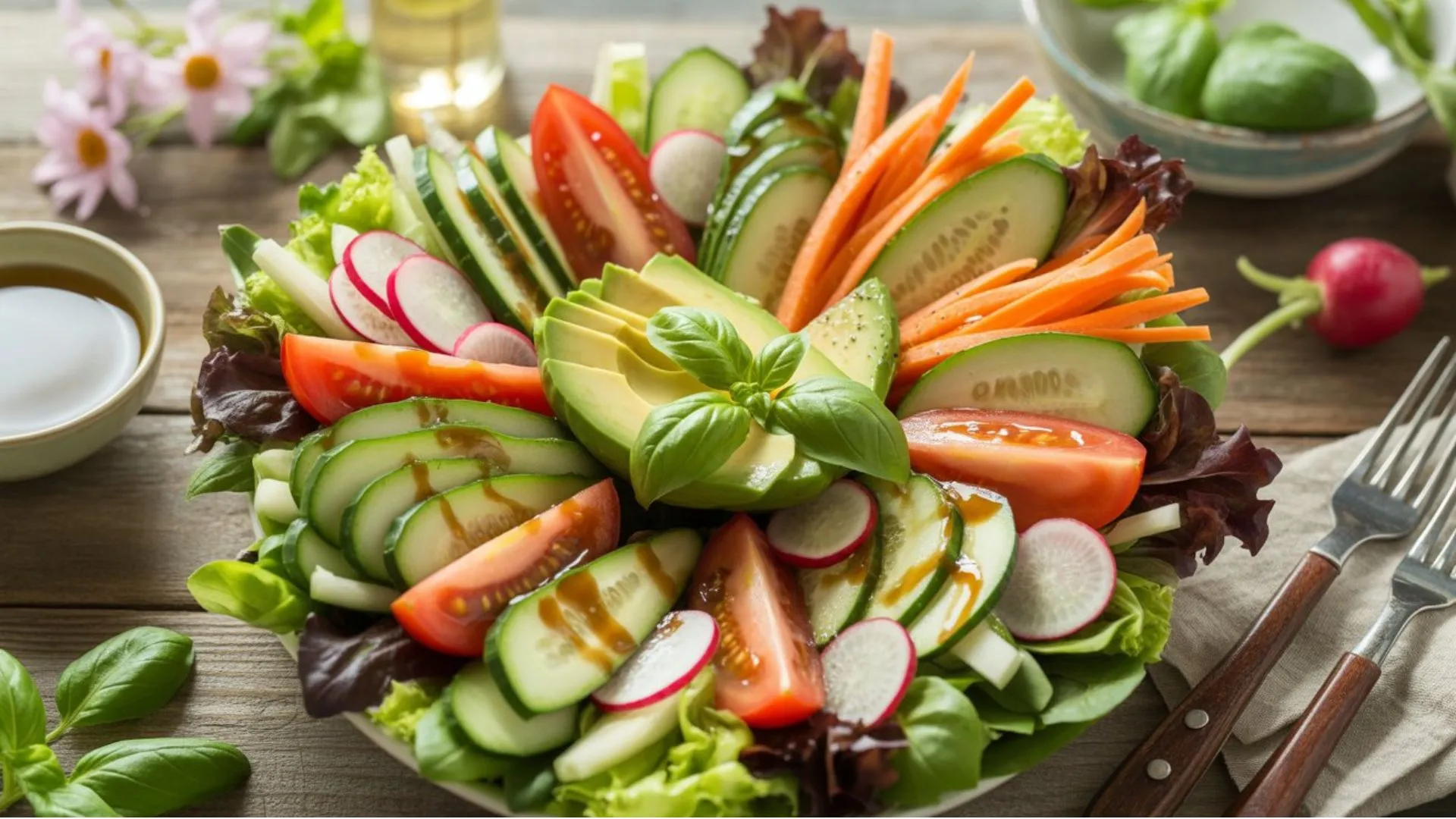
That is exactly what a well-built spring salad recipe delivers. Not just a handful of greens tossed with bottled dressing, but a bowl that actually makes you want to eat it — layered, balanced, and packed with the kind of flavor that only shows up when spring produce is at its absolute peak.
This article walks you through four practical steps that unlock more flavor from every spring salad you make, along with four complete recipes you can put on the table tonight. By the time you finish reading, you will look at your salad bowl in a completely different way.
Why Your Spring Salad Recipe Starts at the Market, Not the Kitchen
Before you reach for a knife or a bowl, the most important decision you make about your spring salad recipe happens the moment you choose your ingredients. Spring produce is not just cosmetically different from what you find in January — it is chemically, nutritionally, and culinarily distinct.
Asparagus harvested in April carries a sweetness that disappears within days of being picked. Radishes pulled from cool spring soil are peppery and snappy in a way that summer heat erases entirely. Peas, arugula, fennel fronds, butter lettuce, fresh herbs — each of these is operating at maximum flavor right now, and your spring salad recipe is only as good as what you bring home from the market.
Here is what to look for when you shop:
- Greens should be deeply colored and show no signs of limpness or yellowing at the edges
- Radishes should feel firm and solid all the way through, not spongy
- Asparagus tips should be tightly closed, not fraying open
- Fresh herbs — mint, tarragon, basil, chives — should smell powerfully of themselves the moment you touch them
- Peas (if fresh) should squeak slightly when rubbed together in the pod
When you build a spring salad recipe on ingredients this fresh, the four steps below do not have to work hard. They amplify what is already there.
The 4 Simple Steps That Transform Every Spring Salad Recipe
These are not complicated techniques. You do not need a culinary degree or specialty equipment. What you need is a shift in how you think about building flavor — and these four steps give you exactly that.
Step 1: Season Your Greens Before You Add the Dressing
Most recipes tell you to make the dressing, pour it on, and toss. That approach leaves flavor on the table. Before your dressing touches anything, lightly season your greens directly with a small pinch of flaky sea salt and, if the recipe calls for it, a tiny amount of acid — a squeeze of lemon, a few drops of vinegar.
Salt draws out the natural moisture in leaves, which concentrates their flavor and helps dressing cling evenly rather than pooling at the bottom of the bowl. This one change alone will make your spring salad recipe taste more deliberately crafted.
Step 2: Build Contrast — Creamy, Crunchy, and Acidic in the Same Bowl
A flat salad is usually missing contrast. When everything in the bowl has the same texture or the same flavor register, your palate stops paying attention after three bites. The solution is intentional contrast:
- Something creamy: goat cheese, avocado, a soft-boiled egg, or a yogurt-based dressing
- Something crunchy: toasted nuts, seeds, croutons, shaved raw vegetables, or crispy chickpeas
- Something acidic: fresh citrus juice, a sharp vinegar, pickled onions, or fermented vegetables
When you hit all three in the same spring salad recipe, the bowl becomes genuinely interesting from the first bite to the last.
Step 3: Use Fresh Herbs as an Ingredient, Not a Garnish
This is the step most people skip, and it is responsible for more bland spring salads than any other mistake. Fresh mint, tarragon, chives, dill, basil, and flat-leaf parsley are not decoration. They are primary flavor contributors, and they should be added in amounts that actually register on your palate.
Think a full quarter-cup of mint leaves, not a few torn pieces scattered on top. Think an entire handful of parsley worked into the base of your greens. When herbs become a real ingredient in your spring salad recipe, the whole dish takes on a brightness and complexity that no dressing can replicate on its own.
Step 4: Finish With a Quality Fat
The last step before you serve is often the most overlooked. After dressing and tossing, finish your spring salad recipe with a final drizzle of really good extra-virgin olive oil, a scatter of toasted nuts, or a few slices of ripe avocado. Fat carries fat-soluble flavor compounds from herbs and produce directly to your taste receptors — it is the reason a salad with a generous drizzle of quality oil tastes three times more satisfying than the same bowl without it.
Quick reminder: Apply all four steps in order — season first, build contrast second, load in the herbs third, and finish with fat last. The sequence matters.
Recipe 1: Classic Spring Green Salad with Lemon Herb Vinaigrette
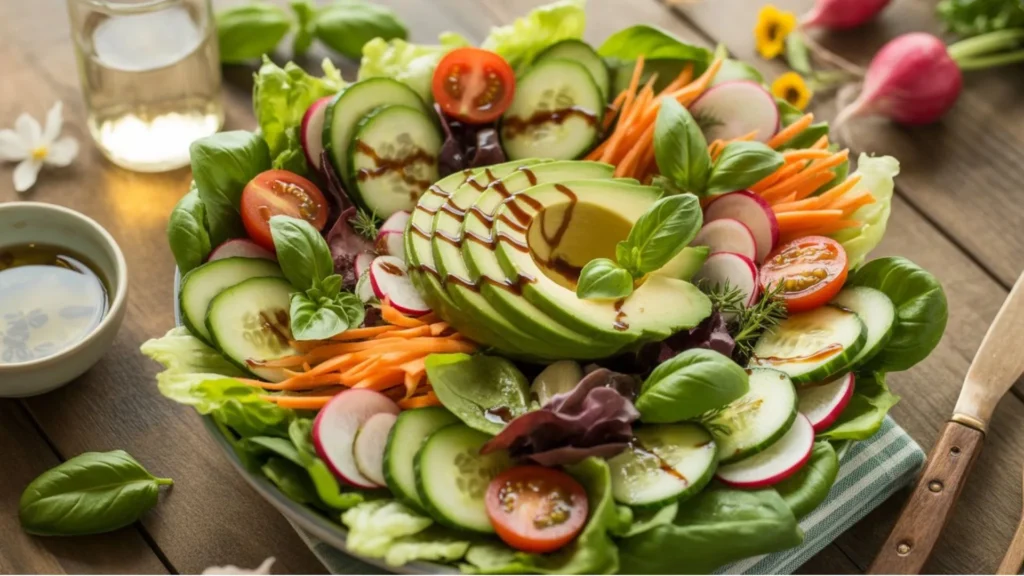
This is the spring salad recipe to reach for when you want something effortlessly elegant. Peppery arugula, delicate butter lettuce, crisp radishes, and shaved fennel come together under a lemon-herb vinaigrette that tastes like the season distilled into a bowl.
Ingredients
- 4 cups baby arugula
- 2 cups butter lettuce, torn by hand
- 6 radishes, sliced paper-thin on a mandoline or sharp knife
- 1/2 cup fennel bulb, shaved into thin ribbons
- 1/4 cup fresh mint leaves
- 1/4 cup flat-leaf parsley, roughly torn
- 3 tablespoons extra-virgin olive oil
- 2 tablespoons fresh lemon juice
- 1 teaspoon Dijon mustard
- Flaky sea salt and freshly cracked black pepper
Instructions
- Whisk together olive oil, lemon juice, Dijon mustard, salt, and pepper in a small jar until fully emulsified.
- Season arugula and butter lettuce with a small pinch of flaky salt (Step 1).
- Layer greens, radishes, and fennel in a wide, shallow bowl.
- Tuck mint and parsley throughout — not just on top (Step 3).
- Dress lightly, toss gently, and finish with a final drizzle of olive oil (Step 4). Serve immediately.
Prep Time: 10 min | Cook Time: 0 min | Total: 10 min
Recipe 2: Strawberry Spinach Spring Salad with Poppy Seed Dressing
Sweet strawberries and baby spinach make this spring salad recipe look stunning on any table. Crumbled goat cheese delivers the creaminess, toasted pecans bring the crunch, and a honey-poppy seed dressing ties every element together with a gentle sweetness that never crosses into cloying.
Ingredients
- 5 cups baby spinach
- 1 cup fresh strawberries, hulled and sliced
- 1/3 cup goat cheese, crumbled
- 1/4 cup pecans, toasted in a dry pan for 3 minutes
- 2 tablespoons red onion, sliced paper-thin
- 3 tablespoons olive oil
- 2 tablespoons apple cider vinegar
- 1 tablespoon raw honey
- 1 teaspoon poppy seeds
- Salt to taste
Instructions
- Whisk olive oil, apple cider vinegar, honey, poppy seeds, and a pinch of salt until combined.
- Season spinach lightly with flaky salt before assembling (Step 1).
- Lay spinach across a wide platter. Arrange strawberries, red onion slices, goat cheese (Step 2 — creamy), and toasted pecans (Step 2 — crunchy) across the top.
- Drizzle dressing evenly over the salad right before serving. Finish with a small drizzle of olive oil (Step 4).
Prep Time: 12 min | Cook Time: 5 min | Total: 17 min
Recipe 3: Asparagus and Pea Spring Salad with Shaved Parmesan
This spring salad recipe bridges the gap between a side dish and a showpiece. Blanched asparagus and sweet green peas cool down over a bed of arugula before meeting a fragrant tarragon vinaigrette and generous shavings of aged Parmesan. Steps 3 and 4 carry this recipe entirely.
Ingredients
- 1 bunch thin asparagus, woody ends removed, cut into 2-inch pieces
- 1 cup fresh or thawed frozen peas
- 3 cups arugula
- 1/4 cup fresh tarragon leaves
- 1/4 cup fresh chives, cut into half-inch lengths
- 1/2 cup Parmesan, shaved with a vegetable peeler
- 3 tablespoons quality extra-virgin olive oil
- 1 tablespoon white wine vinegar
- 1 teaspoon fresh lemon zest
- Salt and cracked black pepper
Instructions
- Bring a pot of well-salted water to a boil. Blanch asparagus and peas for exactly 2 minutes. Transfer immediately to a bowl of ice water to halt cooking and lock in color.
- Whisk olive oil, white wine vinegar, lemon zest, salt, and pepper for the vinaigrette.
- Spread arugula across a large plate. Top with the cooled asparagus and peas.
- Scatter tarragon and chives generously throughout (Step 3). Layer Parmesan shavings across the top and finish with a confident drizzle of olive oil (Step 4).
Prep Time: 10 min | Cook Time: 5 min | Total: 15 min
Recipe 4: Grilled Chicken Spring Salad with Avocado and Herb Dressing
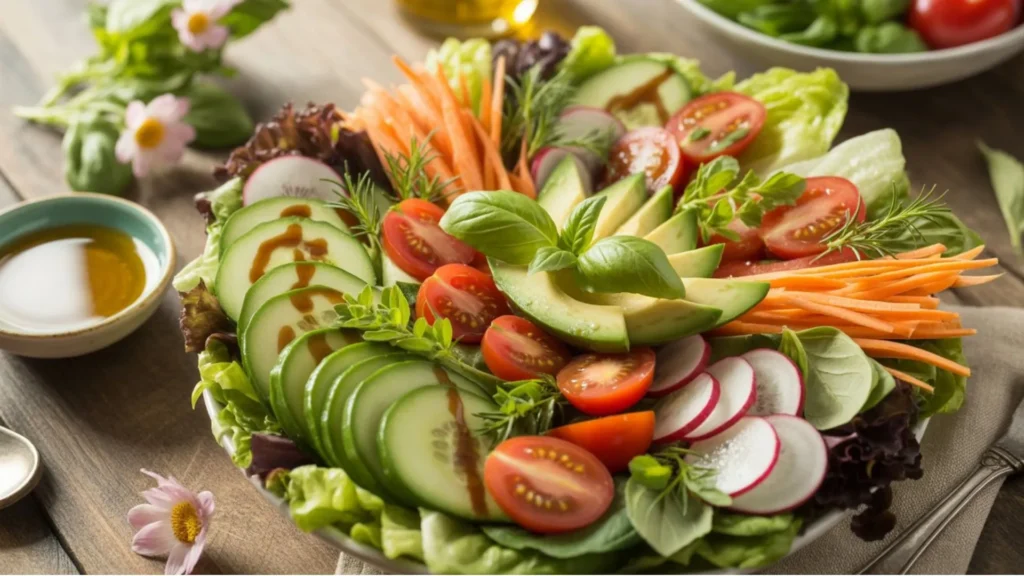
When you want a spring salad recipe that doubles as a complete meal, this is the one. Grilled chicken, creamy avocado, heirloom tomatoes, cool cucumber, and a blended herb dressing built from basil and dill make this hearty, fresh, and deeply satisfying.
Ingredients
- 2 boneless, skinless chicken breasts
- 4 cups mixed spring greens
- 1 large avocado, sliced
- 1 cup heirloom cherry tomatoes, halved
- 1/2 English cucumber, sliced into rounds
- 1/4 cup fresh basil leaves
- 1/4 cup fresh dill fronds
- 3 tablespoons olive oil, plus extra for grilling
- 2 tablespoons fresh lemon juice
- 1 small garlic clove
- Salt and cracked pepper
Instructions
- Season chicken with salt, pepper, and olive oil. Grill over medium-high heat for 6 to 7 minutes per side until cooked through with visible grill marks. Rest for 5 minutes before slicing.
- Blend basil, dill, garlic, olive oil, lemon juice, salt, and pepper together until the dressing is smooth and vivid green.
- Season your spring greens with a pinch of salt before building the bowl (Step 1). Arrange greens, tomatoes, cucumber, and avocado across a wide bowl (Step 2 — creamy avocado, acidic tomatoes).
- Lay sliced chicken over the top. Spoon herb dressing generously across everything. Finish with extra fresh herbs and a final pour of olive oil (Step 4).
Prep Time: 15 min | Cook Time: 15 min | Total: 30 min
Pro Tips That Separate a Good Spring Salad Recipe From a Great One
Even when your ingredients are perfect and your technique is solid, a few habits separate the salads people talk about from the ones they forget. Keep these in your back pocket:
- Spin your greens completely dry after washing. Water sitting on leaves dilutes your dressing and makes greens limp within minutes of being dressed.
- Always dress your spring salad recipe at the very last moment — literally right before it hits the table.
- Toast your nuts and seeds, every single time. Two to three minutes in a dry skillet over medium heat releases oils and produces flavor that raw nuts simply cannot match.
- Taste and adjust your dressing before it goes on. A good dressing should taste slightly stronger and slightly more acidic than you think you want — the greens will balance it.
- Do not crowd the bowl. A wide, shallow platter lets every component breathe and makes the salad visually dramatic enough to make people reach for it before they even taste it.
One last thought: a spring salad recipe is most powerful when you treat it as a whole dish, not a side. Give it the same attention you would give any main course, and it will reward you every time.
Conclusion: Four Steps That Change Everything
Here is what it all comes down to: a spring salad recipe does not need to be complicated to be extraordinary. It needs to be intentional. When you season your greens before dressing, build real textural contrast, treat fresh herbs like a main ingredient rather than a finishing touch, and close every bowl with a quality fat — the results speak for themselves.
The four recipes in this guide each demonstrate those steps in a different way, with different produce, different proteins, and different flavor profiles. But the principle running through all of them is the same. Fresh seasonal ingredients, handled with a little care, produce something worth sitting down for.
Now it is your turn. Pick the recipe that speaks to you today, head to your nearest farmers market or grocery store, and build something that actually tastes like spring. Then share it — with your household, your guests, or your social feed. Once people taste a spring salad recipe built with this much intention, they will be asking you for it all season long.
Further Reading
Want to go deeper on healthy eating and seasonal cooking? These resources are worth bookmarking: Healthy Recipes and Diet Nutrition Guide and Carlsbad Cravings Spring Salad Collection.
Frequently Asked Questions: Spring Salad Recipe
Q: What is the key to a flavorful spring salad recipe?
The key is treating flavor as something you build deliberately rather than something that just happens. Season your greens with a pinch of salt before dressing, build textural contrast in every bowl, use fresh herbs as a real ingredient rather than decoration, and always finish with a quality fat. Those four steps make more difference than any single ingredient.
Q: Which vegetables work best in a spring salad recipe?
Asparagus, radishes, sugar snap peas, arugula, butter lettuce, shaved fennel, spring onions, and fresh peas are all at their best right now. Choose whatever looks most vibrant at your market — peak-season produce will always outperform off-season ingredients regardless of what recipe you follow.
Q: Can you make a spring salad recipe ahead of time?
You can prep every component separately up to 24 hours in advance — washed and dried greens stored in the refrigerator, dressing made and jarred, proteins cooked and cooled, vegetables blanched or sliced. The only step you should wait on is combining and dressing the bowl itself, which should happen right before serving.
Q: What protein pairs best with a spring salad recipe?
Grilled chicken, poached salmon, soft-boiled or hard-boiled eggs, seared halloumi, or warm chickpeas all work beautifully. Choose based on the flavor direction of your dressing — citrus-herb dressings pair well with chicken and fish, while a poppy seed or balsamic dressing plays nicely with eggs and cheese.
Q: How do you stop a spring salad recipe from turning soggy?
Three habits prevent soggy salads entirely: dry your greens completely after washing (a salad spinner is worth owning), dress only at the last moment, and store any leftover components separately in airtight containers rather than storing an already-dressed salad.
Have You Given This Recipe A Try?
There are no reviews yet. Be the first one to write one.