

Table of Contents
You open the fridge, reach for that plastic tub, flip it over — and suddenly you’re reading a list of ingredients that sounds more like a chemistry experiment than food. Guar gum. Locust bean gum. “Natural flavors.” You just wanted cottage cheese.
Here’s the thing most people don’t know: cottage cheese is one of the easiest fresh cheeses you can make in your own kitchen. No special tools. No cheesemaking experience. Just milk, something acidic, a pot, and maybe thirty minutes of your time. What you get on the other side is a bowl of soft, creamy, clean-tasting curds that put the store-bought version to shame — every single time.
This guide will walk you through the full process: the classic recipe, three flavor variations that will keep things interesting, the tips that make a real difference, and smart ways to use what you’ve made. By the end, you’ll understand exactly why so many home cooks, once they make cottage cheese themselves, never go back to buying it.
What Cottage Cheese Actually Is (And Why It’s Worth Making)
Cottage cheese is a fresh, unaged cheese. That means it doesn’t go through the long fermentation and aging process that hard cheeses like cheddar or parmesan require. Instead, you simply warm milk, add an acid — vinegar or lemon juice — which causes the proteins to clump together into soft white curds. Those curds are drained, rinsed, and finished with a splash of cream or milk. That’s the whole process.
What Makes Homemade Better
The difference between homemade and store-bought isn’t subtle. Here’s what changes when you make it yourself:
- Flavor — store-bought cottage cheese often has a faint sourness from the stabilizers; homemade tastes clean, fresh, and milky
- Texture — you control the curd size and creaminess entirely
- Ingredients — three items on your label versus twelve on the tub
- Protein content — one cup of cottage cheese delivers around 25 grams of protein, according to the USDA; homemade from whole milk gives you all that without the additives
- Cost — a half-gallon of whole milk costs roughly $3–4 and yields about two full cups of cottage cheese
If you’re interested in exploring other simple homemade dairy projects, this homemade cottage cheese pairs well with techniques used in making fresh cheeses. You can also learn another easy approach from this homemade cottage cheese recipe for additional tips and variations.
Everything You Need Before You Start

The Right Milk Matters More Than Anything
Your milk is the foundation of this recipe, and one choice can ruin the whole batch before it even begins.
Use regular pasteurized whole milk. Full-fat gives you the richest flavor and the best yield. Two percent works but produces a leaner, less creamy result.
Never use ultra-pasteurized (UHT) milk. The high-heat processing used to extend shelf life damages the milk proteins in a way that prevents them from curdling correctly. Check the label carefully — UHT milk is common in organic and specialty brands. If it says “ultra-pasteurized,” leave it on the shelf.
Your Acid Options
You have two reliable choices:
- White distilled vinegar — neutral flavor, consistent results, and most readily available
- Fresh lemon juice — slightly milder, with a hint of brightness that some people prefer
Either works at the same quantity: 3 tablespoons per half-gallon of milk. Avoid apple cider vinegar — it adds an off-flavor to the finished cheese.
Equipment You’ll Need
Nothing specialized required. Here’s what to gather:
- A large, heavy-bottomed pot (at least 3-quart capacity)
- An instant-read thermometer — this is genuinely important, not optional
- A colander
- Cheesecloth (2–3 layers) or a thin, clean kitchen towel
- A large bowl to catch the whey
Classic Homemade Cottage Cheese
Three ingredients, one pot, and the freshest cottage cheese you’ve ever tasted.
This is the base recipe — the one you’ll come back to every week once you see how straightforward it is. Everything else in this guide builds from here.
Ingredients (Makes approximately 1.5–2 cups)
- 1/2 gallon (8 cups) whole milk — regular pasteurized, not UHT
- 3 tablespoons white vinegar or fresh lemon juice
- 1/2 teaspoon fine sea salt
- 2–4 tablespoons heavy cream or whole milk (for finishing — optional but recommended)
Instructions
Step 1 — Warm the milk slowly. Pour your milk into the pot and set the heat to medium-low. Stir occasionally to prevent a skin from forming on the surface. You’re aiming for 185°F (85°C). At this temperature you’ll see steam rising steadily and small bubbles forming around the edges — but it should not be a rolling boil. A thermometer takes the guesswork out completely.
Step 2 — Add your acid and step back. Remove the pot from heat. Pour in your vinegar or lemon juice and give it one or two gentle stirs — no more. Then leave it completely undisturbed for 5 to 10 minutes. This is where the separation happens: the milk splits into white curds and a pale, yellowish liquid called whey. Resist the urge to stir it.
Step 3 — Check the separation. After ten minutes, look at the liquid around the curds. It should appear mostly clear or pale yellow, not milky white. If it’s still opaque, add another tablespoon of acid, stir gently once, and wait another five minutes.
Step 4 — Drain the curds. Line your colander with cheesecloth (or your kitchen towel) and set it over a large bowl to catch the whey. Ladle or gently pour the curds and whey into the colander. Don’t rush this — slow and steady keeps the curds intact.
Step 5 — Rinse with cool water. Run cool water gently over the curds for about 30 seconds. This step does two things: it stops the cooking (preventing rubbery curds) and washes off the acidic flavor, leaving you with a clean, fresh taste. Don’t skip this.
Step 6 — Drain to your preferred texture. For wet, spoonable cottage cheese, let it drain for 5–10 minutes. For a firmer, drier texture, gather the cheesecloth into a bundle and squeeze gently, or hang it over the bowl for 15–20 minutes. The longer it drains, the denser it becomes.
Step 7 — Season and finish. Transfer the curds to a bowl. Add your salt and stir to combine. Then fold in cream or milk — 2 tablespoons for a lighter finish, 4 tablespoons for something richer and more indulgent. Taste and adjust salt.
Timing at a Glance
| Stage | Time |
|---|---|
| Preparation | 5 minutes |
| Cooking (warming milk) | 15 minutes |
| Resting + draining | 10–20 minutes |
| Total | 30–40 minutes |
Store in an airtight container in the refrigerator for up to 5 days.
Three Cottage Cheese Variations Worth Trying
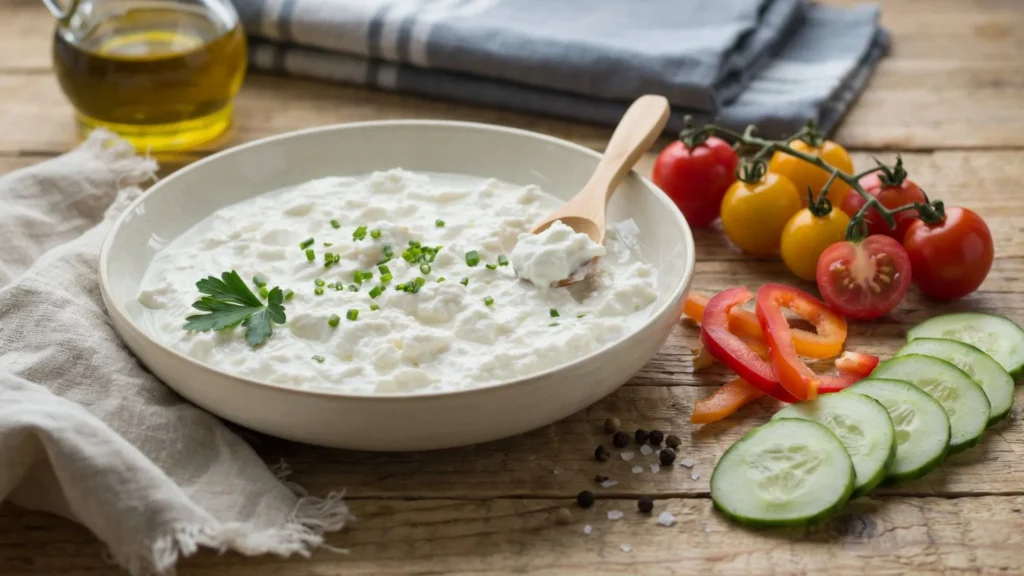
Once you’re comfortable with the base recipe, these variations take almost no extra time and open up a whole new range of uses.
Herb & Garlic Cottage Cheese
A savory, spreadable version that works on toast, as a dip, or alongside roasted vegetables.
Ingredients
- 1.5 cups homemade cottage cheese
- 1 small garlic clove, finely minced or roasted and mashed
- 2 tablespoons fresh chives, finely chopped
- 1 tablespoon fresh dill (or 1 teaspoon dried)
- 1/4 teaspoon cracked black pepper
- Pinch of flaky salt
Instructions
Prepare your base cottage cheese fully, including the cream finish. Fold in all the remaining ingredients. Let it rest in the fridge for at least 10 minutes before serving — the flavors develop quickly and the wait is worth it.
| Prep Time | Cook Time | Total Time |
|---|---|---|
| 5 minutes | 0 minutes | 5 minutes + base recipe |
Sweet Honey & Vanilla Cottage Cheese
A clean, lightly sweetened version that replaces yogurt in breakfast bowls, smoothies, and fruit parfaits.
Ingredients
- 1.5 cups homemade cottage cheese (use the extra cream for a smoother finish)
- 1.5 tablespoons raw honey or pure maple syrup
- 1/2 teaspoon pure vanilla extract
- Small pinch of cinnamon (optional)
- Fresh berries or banana slices to serve
Instructions
Combine honey and vanilla in a small bowl and stir together. Fold the mixture into your finished cottage cheese. Add cinnamon if using. Serve immediately topped with fruit, or refrigerate up to two days.
| Prep Time | Cook Time | Total Time |
|---|---|---|
| 5 minutes | 0 minutes | 5 minutes + base recipe |
Spicy Jalapeño & Lime Cottage Cheese
A punchy, bold variation that works as a taco topping, egg mix-in, or chip dip.
Ingredients
- 1.5 cups homemade cottage cheese
- 1 small jalapeño, seeds removed and finely diced
- 1 tablespoon fresh lime juice
- 1 tablespoon fresh cilantro, roughly chopped
- 1/4 teaspoon ground cumin
- Salt to taste
Instructions
Fold all ingredients into your finished cottage cheese. For more heat, keep some of the jalapeño seeds. Chill for 15 minutes before serving — the lime and cumin bloom a little as it sits.
| Prep Time | Cook Time | Total Time |
|---|---|---|
| 5 minutes | 0 minutes | 5 minutes + base recipe |
The Tips That Actually Change the Result
You can follow a recipe perfectly and still end up with watery, grainy, or bland cottage cheese if you miss a few key things. Here’s what separates a good batch from a great one:
Don’t Over-Stir After Adding Acid
One or two gentle stirs is all you need. The more you disturb the milk after adding the acid, the smaller and grainier your curds become. Larger curds = creamier texture.
Temperature Is Non-Negotiable
Under 185°F and the milk doesn’t separate properly. Over 200°F and you risk scorching the bottom of the pot and making the curds tough. Use the thermometer every time until you know your stove well enough to feel it.
Always Rinse the Curds
This is the step most first-timers skip, thinking it’s unnecessary. It isn’t. The rinse removes the acidic edge, firms the curds slightly, and dramatically improves the final taste.
Let the Whey Work for You
Don’t pour the leftover whey down the drain. It’s protein-rich and genuinely useful:
- Add it to bread or pizza dough instead of water
- Blend into smoothies for a protein boost
- Use as a cooking liquid for oats or rice
- Water your garden plants — it’s nitrogen-rich
Six Smart Ways to Use Your Cottage Cheese

You’ve made a batch — now what? Here’s where cottage cheese earns its spot in your kitchen well beyond eating it by the spoonful:
- Breakfast parfait — layer with granola, honey, and fresh berries for a high-protein start to your day Homemade cottage cheese is also a great ingredient for quick desserts and snacks that require no oven time. If you enjoy easy make-ahead treats, browse these no-bake recipes for more inspiration.
- Smoothie booster — blend a quarter cup into any fruit smoothie for creaminess and protein without the flavor
- Lasagna filling — swap ricotta for cottage cheese in lasagna or stuffed pasta shells; it melts beautifully
- Scrambled eggs — fold two tablespoons into your eggs in the last 30 seconds of cooking for an extra-creamy result
- Protein pancakes — replace buttermilk with cottage cheese in your pancake batter for a fluffy, protein-dense stack
- Grain bowl base — use it the way you’d use hummus or tzatziki — as the creamy base underneath roasted vegetables and grains
Conclusion
Making cottage cheese at home isn’t a weekend project or a complicated undertaking. It’s a thirty-minute routine that gives you something genuinely better than what’s sitting on the grocery shelf — fresher flavor, a cleaner ingredient list, and the quiet satisfaction of knowing exactly what went into your food.
Start with the classic recipe this week. Make one batch, taste it, and then decide which variation you want to try next. Once you find your version — whether that’s creamy and herb-flecked, sweetened with honey for breakfast, or punched up with jalapeño — it becomes part of your regular rotation without any effort at all.
Your turn: make a batch this week, try one of the variations, and see which one becomes your go-to. If you find a combination that works brilliantly, share it — the best recipes always start with someone willing to experiment in their own kitchen.
Frequently Asked Questions About Cottage Cheese
Can I make cottage cheese without vinegar?
Yes. Fresh lemon juice works just as well and produces a slightly milder flavor. Use the same quantity — 3 tablespoons per half-gallon of milk. Citric acid dissolved in water is a third option, commonly used in professional cheesemaking.
Why didn’t my cottage cheese curdle properly?
The most likely cause is ultra-pasteurized milk. Check your label carefully — if it says “ultra-pasteurized” or “UHT,” it won’t curdle with acid. Regular pasteurized whole milk always works. Also confirm your milk reached 185°F before adding the acid.
How long does homemade cottage cheese stay fresh?
Stored in an airtight container in the refrigerator, your cottage cheese will stay fresh for 4 to 5 days. Because there are no preservatives, it won’t last as long as a store-bought tub.
Is homemade cottage cheese actually healthier?
For most people, yes. You get all the protein (around 25 grams per cup) with none of the stabilizers, gums, or artificial flavors present in most commercial versions. You also control the salt level and milk fat percentage, making it easy to adjust for your dietary needs.
Can I use low-fat or skim milk?
You can, but the yield drops significantly and the flavor becomes noticeably thinner. If you’re set on a lower-fat version, use 2% milk and compensate with a bit of extra cream at the finishing stage to bring back some richness.
What do I do with the leftover whey?
Use it. Whey is protein-rich and works as a substitute for water in bread dough, a smoothie booster, or a cooking liquid for oats and rice. It also makes an excellent plant fertilizer thanks to its nitrogen content. One batch of cottage cheese gives you roughly 6 cups of whey — that’s a lot of potential.