
Table of Contents
My first attempt at canning tomatoes ended with me standing in my kitchen at midnight, Googling “is it normal for a lid to not pop,” while my husband tried to convince me the jars were fine and I tried to convince him we were both about to get food poisoning. They weren’t fine, as it turned out — I’d skipped a step I didn’t even know mattered, and the whole batch went in the trash. That night sent me down a rabbit hole of actual USDA guidelines, and it changed how I’ve approached canning tomatoes recipes ever since. There’s a right way to do this, and it’s not complicated once you understand why each step exists.
If you’ve got a counter full of ripe tomatoes and you’re searching for canning tomatoes recipes that won’t leave you second-guessing every jar for the next year, this is the guide I wish I’d found first. I’m going to walk you through the tested, USDA-backed method for canning whole tomatoes step by step, explain the handful of mistakes that actually matter, and answer the questions that come up most when people start canning tomatoes for the first time.
Why Acid Is the Whole Story Here
Here’s the one thing that separates safe canning tomatoes recipes from risky ones: acid. Tomatoes sit right at the edge of the safety threshold — their natural pH can range from about 4.5 to 4.8, and anything above 4.6 falls into “low-acid” territory, which is where the bacteria that causes botulism can potentially grow in a sealed jar. Modern tomato varieties, over-ripe fruit, and tomatoes from frost-damaged vines can all push that pH even higher, and there’s no way to tell just by looking or tasting.
That’s why every tested method calls for adding a measured amount of bottled lemon juice or citric acid to each jar before processing, regardless of how “acidic” your tomatoes taste or what variety you’re using. It’s a small step that makes the entire process safe, and it’s not optional — no old-fashioned method, heirloom variety, or family shortcut changes that math. Once you build that habit, the rest of the process is genuinely straightforward.
Key Takeaways Before You Start
- Always add bottled lemon juice or citric acid to every jar — never skip this step, regardless of tomato variety.
- Only use bottled lemon juice, not fresh-squeezed — bottled juice has a standardized, reliable acidity level.
- Select firm, disease-free, preferably vine-ripened tomatoes; avoid fruit from dead or frost-damaged vines.
- Follow tested processing times exactly — don’t shorten them, even if your jars look “done” sooner.
- Adjust processing time for your elevation if you live above 1,000 feet.
Canning Tomatoes Recipes: Step by Step (Whole Tomatoes in Water)
Prep time: 30 minutes | Cook/process time: 40–45 minutes | Total time: About 1 hour 15 minutes | Yield: About 7 quarts or 9 pints (roughly 21 pounds of tomatoes per 7-quart canner load)
Ingredients
Canning Tomatoes Recipe
Ingredients
Instructions
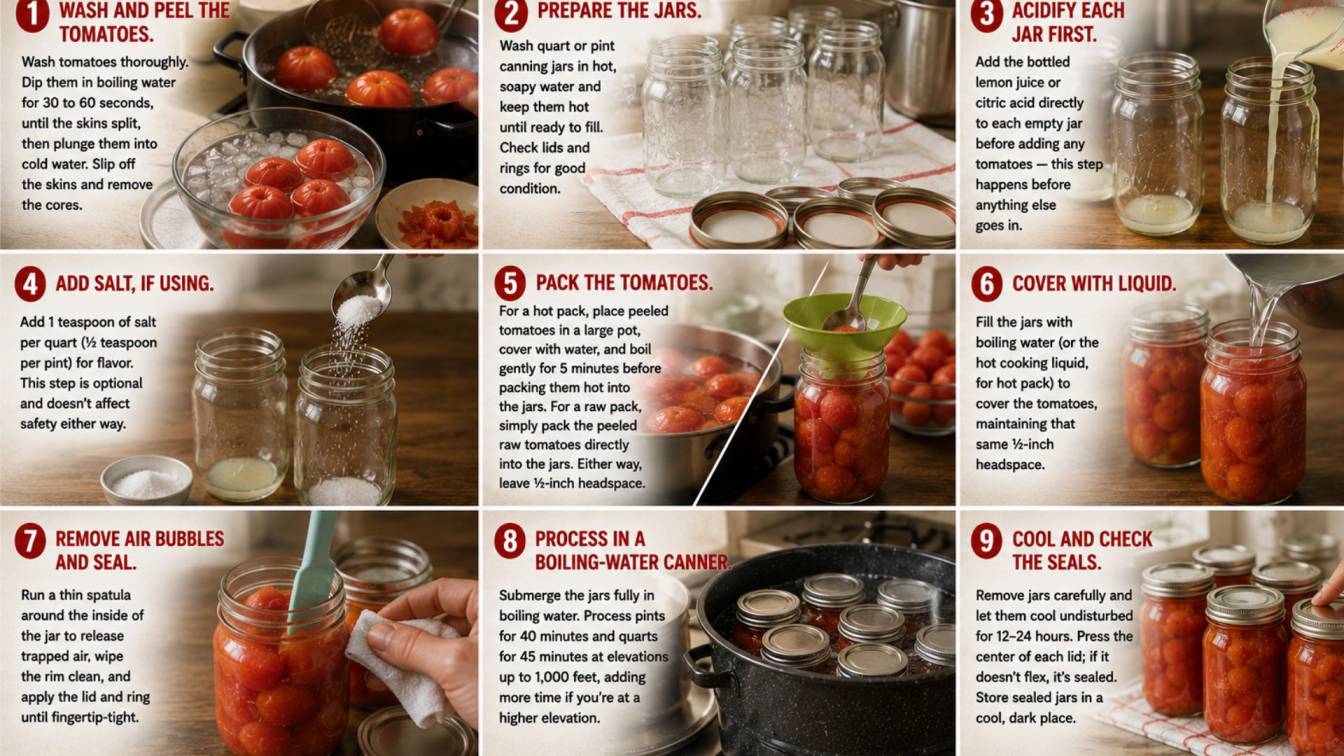
1-Wash and peel the tomatoes.
Wash tomatoes thoroughly. Dip them in boiling water for 30 to 60 seconds, until the skins split, then plunge them into cold water. Slip off the skins and remove the cores.
2-Prepare the jars.
Wash quart or pint canning jars in hot, soapy water and keep them hot until ready to fill. Check lids and rings for good condition.
3-Acidify each jar first.
Add the bottled lemon juice or citric acid directly to each empty jar before adding any tomatoes — this step happens before anything else goes in.
4-Add salt, if using.
Add 1 teaspoon of salt per quart (½ teaspoon per pint) for flavor. This step is optional and doesn’t affect safety either way.
5-Pack the tomatoes.
For a hot pack, place peeled tomatoes in a large pot, cover with water, and boil gently for 5 minutes before packing them hot into the jars. For a raw pack, simply pack the peeled raw tomatoes directly into the jars. Either way, leave ½-inch headspace.
6-Cover with liquid.
Fill the jars with boiling water (or the hot cooking liquid, for hot pack) to cover the tomatoes, maintaining that same ½-inch headspace.
7-Remove air bubbles and seal.
Run a thin spatula around the inside of the jar to release trapped air, wipe the rim clean, and apply the lid and ring until fingertip-tight.
8-Process in a boiling-water canner.
Submerge the jars fully in boiling water. Process pints for 40 minutes and quarts for 45 minutes at elevations up to 1,000 feet, adding more time if you’re at a higher elevation.
9-Cool and check the seals.
Remove jars carefully and let them cool undisturbed for 12–24 hours. Press the center of each lid; if it doesn’t flex, it’s sealed. Store sealed jars in a cool, dark place.
Common Mistakes to Avoid
The single biggest mistake in canning tomatoes recipes is skipping the acid altogether, usually because a tomato “tastes acidic enough” — taste has nothing to do with actual pH, so this shortcut isn’t safe no matter how tart the fruit seems. Another common error is shortening the processing time because the jars appear sealed early; the timer only starts once the water reaches a full rolling boil, and cutting it short means the jars may not reach a safe internal temperature. Overcrowding the canner or using cracked jars can also prevent a proper seal, so give jars room to breathe and inspect them beforehand.
Frequently Asked Questions
Do you have to add lemon juice when canning tomatoes?
Yes, always. Bottled lemon juice (or citric acid) brings the tomatoes’ pH down to a safely acidic level for boiling-water canning, regardless of the variety or how ripe the fruit is. Skipping it is the most common cause of unsafe home-canned tomatoes.
How do you avoid botulism when canning tomatoes?
The two biggest safety factors are proper acidification with bottled lemon juice or citric acid and following tested processing times exactly. Together, these ensure the jar’s contents reach a pH and temperature that prevent the growth of the bacteria responsible for botulism.
Are 3-year-old canned tomatoes safe to eat?
If the jar sealed properly, has been stored in a cool, dark place, and shows no signs of spoilage — no bulging lid, off smell, or discoloration — it’s generally still safe, though quality and flavor decline over time. Most guidance recommends using home-canned goods within 12–18 months for best quality, even if they remain technically safe longer.
How many jars does 25 lbs of tomatoes make?
Roughly 25 pounds of tomatoes will yield close to 8 quart jars, since the standard ratio is about 3 pounds of tomatoes per quart. If you’re working with pint jars instead, that same 25 pounds would fill approximately 16 pints.
Final Thoughts
Once you understand why each step exists, canning tomatoes stops feeling like a mysterious kitchen ritual and starts feeling like what it actually is: a simple, repeatable process that turns a summer’s worth of tomatoes into shelf-stable meals for the rest of the year. If you want to explore more ways to put up your tomato harvest, this collection of tomato canning recipes from Creative Canning is a great next stop. And if you’re planning what to serve alongside your pantry staples, these snack and appetizer recipes pair well with anything made from a jar of home-canned tomatoes.
Give this method a try the next time your tomato harvest gets out of hand, and let me know in the comments how your first batch turns out. And if you want to save this guide or see what else I’m putting up this season, come find me on Pinterest @PalatableRecipesDotCom — new pins go up every week.